

Board Performance · 2025
In this section14 topics
- Prevention of Conflicts of Interest4 items
- Prevention of the Use of Inside Information4 items
- Anti-Corruption5 items
- Whistleblowing3 items
- Selection of Directors & Chief Executives6 items
- Selection of Independent Directors2 items
- Director Development3 items
- Evaluation of Board & Subcommittee Performance2 items
- Subcommittees1 item
- Meeting Attendance & Remuneration6 items
- Supervision of Subsidiaries & Associated Companies5 items
- Board Duty Performance — Overview1 item
- Audit Committee Duty Performance2 items
- Executive Committee Duty Performance1 item
Prevention of Conflicts of Interest
Operations — Introduction
Demco has a policy to enhance and promote its corporate governance framework. The company has established additional guidelines for the Board of Directors and the Chief Executive Officer, including the establishment of a yearly meeting plan for the Board of Directors, requiring the Board of Directors to meet with the auditors without the presence of management at least once a year, and requiring the Board of Directors to consider various reports, such as risk management and sustainable supply chain development, at least twice a year, including reviewing the internal audit report at every Board of Directors meeting.
The Board of Directors has overseen compliance with the requirements for procedures and disclosure of conflicts of interest. This is in accordance with the guidelines of the Securities and Exchange Commission (SEC), the Stock Exchange of Thailand, and relevant regulatory agencies. An audit committee has been appointed to consider, approve, and provide opinions on transactions that may involve conflicts of interest. In addition, Demco has established a code of conduct and defined the scope of business dealings with related parties by specifying the types and approval processes for transactions that may involve conflicts of interest, which are transactions that the company conducts in the ordinary course of business.
The company has implemented and monitored compliance with good corporate governance principles, such as
1. Employee care and non-discrimination
2. Antitrust and fair competition
3. Environmental, health, and safety management
4. Information security
Has the Company Acted to Prevent Conflicts of Interest?
Yes
Operations in the Past Year
Conflict of Interest Prevention
The Board of Directors considers the conflict between personal interests and the interests of the Company as a crucial policy. It is defined as a good corporate governance policy and sets out guidelines for directors, executives, and employees in the Code of Business Conduct and Ethics. This code mandates that directors, executives, and employees must disclose their interests and those of related parties that may pose a conflict of interest. This practice aims to prevent the exploitation of their positions as directors, executives, or employees of DEMCO for personal gain. DEMCO has established the following guidelines for its directors, executives, and employees:
1) Directors, executives, and employees should avoid engaging in transactions that are considered connected transactions as per the Capital Market Supervisory Board's notifications, which may give rise to conflicts of interest with DEMCO, both directly and indirectly.
2) The Board of Directors must establish measures to monitor and oversee transactions that may involve conflicts of interest. The appropriateness of such transactions must be carefully and independently considered within the framework of good corporate governance in conducting transactions that may involve conflicts of interest.
3) In the event that DEMCO's directors, executives, and employees need to engage in related party transactions that are reasonable and in the best interests of DEMCO, such transactions must be conducted as if DEMCO were transacting with an outside party. The pricing and terms of the transaction must adhere to the principles of fairness and arm's length basis, or in accordance with DEMCO's relevant policies. A report on such transactions must be submitted to the Audit Committee and the Board of Directors for acknowledgement every quarter. Directors, executives, or employees of DEMCO who have an interest in such transactions are prohibited from participating in the consideration, approval, or authorization of such transactions.
4) Do not seek benefits for oneself or others by using or disclosing undisclosed or confidential inside information to external parties. This should be in accordance with DEMCO's Insider Information Policy to ensure fairness to all stakeholders. Directors and executives must report their interests or those of related parties in cases where there are interests related to the management of DEMCO's business. The reporting of interests by directors and executives is as follows:
a) Initial Report: A report must be submitted to the Company Secretary upon the director or executive assuming the position of director or executive.
b) Reporting Changes in Interest Information: Report any changes in information without delay within 3 business days from the date of the change, specifying the number of times the information has been changed.
c) Report of Conflicts of Interest or Significant Related Party Transactions: The Company's directors and executives who have a conflict of interest or are significantly related to the agenda items under consideration must notify the Company Secretary. This notification, to be reported to the Board of Directors, should detail their relationship or interest in said agenda items no later than the Board meeting's commencement. This information must be recorded in the minutes of that Board of Directors meeting. These individuals must abstain from participating in the deliberation and shall have no authority to approve such transactions.
DEMCO considers the conflict of interest prevention policy to be of paramount importance. Therefore, DEMCO's Audit Committee has established guidelines on conflicts of interest and conducts regular reviews to ensure that the implementation of the control system is standardized and transparent.
Number of Conflict-of-Interest Cases
| Metric | Current Year | Previous Year | Two Years Ago |
|---|---|---|---|
| Total number of cases or issues related to conflicts of interest (cases) | 0 | 0 | 0 |
Prevention of the Use of Inside Information
Introduction
The Company places great importance on the use of the Company's inside information for personal gain. The Company has established a policy on the management of confidential information and information that may affect the price of securities, along with guidelines in the DEMCO Code of Business Conduct and Code of Conduct, as follows:
Policy
1) DEMCO shall provide knowledge and understanding to the Board of Directors and executives of DEMCO regarding the reporting of shareholding and changes in shareholding of the Company to the SEC according to Section 59 and 258 of the Securities and Exchange Act B.E. 2535, SEC Notification No. Sor Chor. 6/2567 Re: Reporting of Changes in Securities Holding and Futures Contracts of Directors, Executives, Auditors, Planners and Plan Administrators, including the Act and subsequent amendments to the announcements. It is specified that the Company Secretary must be notified each time in order to inform relevant parties, including the penalties for violation or non-compliance with such regulations.
2) The Board of Directors, executives as defined by the SEC, and auditors, including related persons as prescribed by the SEC Office, are required to report their shareholding in DEMCO for the first time upon appointment and whenever there is a change, including the number of shares held by related persons according to Sections 59 and 258 of the Securities and Exchange Act, and report changes in shareholding to the Board of Directors meeting each time for acknowledgement.
3) It is specified in the employment contract, including the company's binding rules regarding work, standards of conduct for executives and employees, which are considered to be the ethics and code of conduct of employees in carefully maintaining the confidentiality of DEMCO's information, not using their position in DEMCO or using inside information or material non-public information obtained during their employment with DEMCO for improper personal gain or disclosing it to outsiders for personal gain and that of related parties, or causing DEMCO to suffer a loss or acting in a manner that creates a conflict of interest.
4) Give importance to protecting the confidential information of customers seriously and consistently, without using such information for the benefit of oneself and related parties, except for information that is public or information that must be disclosed to outsiders according to relevant laws.
5) In the event that an outside party is involved in an ad hoc work related to information that is not yet publicly available and is under negotiation, which falls under the scope of insider information that may affect the share price of DEMCO, such outside party must enter into a Confidentiality Agreement with the Company in accordance with the Confidentiality Agreement Policy until the information is disclosed to the Stock Exchange of Thailand and the SEC Office.
6) Establish policies and practices for the use of network and computer systems, governance of information technology and communication security to control and maintain the security of information in the information system and/or prevent access to DEMCO's information by outsiders and define the level of access to DEMCO's information for executives and employees at different levels to be appropriate to their responsibilities.
7) Penalties shall be imposed in accordance with DEMCO's regulations if it is found that an executive or employee or related person has used inside information or has engaged in conduct that could cause damage or loss to DEMCO.
8) Report to the Board of Directors on a quarterly basis in the event of insider information being used or conduct that could cause damage or loss to DEMCO.
9) The Chief Executive Officer, Managing Director, Company Secretary or authorized person shall have the authority to disseminate the Company's information and provide information to outsiders.
10) The Regulatory and Control Unit is responsible for maintaining the register and reviewing the list of persons designated by the Company on an annual basis and notifying the manager or head of department and such persons when they are added/removed from the register.
Practices
1) Reporting of DEMCO shareholding in the case of directors and executives as defined by the SEC who are newly appointed and are not yet listed in the system of directors and executives of listed companies notified to the SEC Office, report within 7 business days from the date of purchase, sale, transfer or receipt of transfer and the Company has notified the names of directors and executives in the manner prescribed by the SEC Office. The report on changes in shareholding, including spouses or cohabitants as husband and wife and unemancipated children, as well as related persons, according to Section 59 of the Securities and Exchange Act B.E. 2535 and subsequent amendments to the announcements, must be submitted within 3 business days from the date of purchase, sale, transfer or receipt of transfer to the SEC Office by reporting through the SEC Office's website including the prohibition of trading in the Company's securities during the 1 month period prior to the public release of the financial statements.
2) Report of changes in shareholding in the case of directors and executives as defined by the SEC, including spouses or cohabitants as husband and wife and unemancipated children, as well as related persons, according to Section 59 of the Securities and Exchange Act B.E. 2535 and subsequent amendments to the announcements, from the date of purchase, sale, transfer or receipt of transfer to the SEC Office by reporting through the SEC Office's website at E-service: Form 59, including the prohibition of trading in the Company's securities during the 1 month period prior to the public release of the financial statements. The reporting period is as follows:
2.1 In the case of a value equal to or greater than 3 million baht, it must be reported within 3 business days (T+3) from the date of the transaction of buying, selling, transferring or receiving transfers of securities and futures contracts.
2.2 In the case of a transaction value of less than 3 million baht, reporting can be chosen.
• For a value of less than 3 million baht, you can choose to report within 3 business days (T+3) or
• When the total value of trading, selling, transferring or receiving transfers of securities and futures contracts is equal to or greater than 3 million baht, report within 3 business days (T+3).
• In the case of an accumulated value of 3 million baht or more, report within 3 business days (T+3), except for the amount already reported, there is no need to carry forward the original amount to the report.
• Or report every 6 months, report within 3 business days (T+3) from the first day of not reporting to the SEC, even if the accumulated value is less than 3 million baht.
Note:
- T means the transaction date, the date the accumulated value reaches 3 million baht, or the date the 6-month period expires, as the case may be.
- Count only business days, excluding holidays.
2.3 Send a copy of the shareholding change report to the SEC Office on the same day as the report is submitted to the SEC Office by sending it to the Company Secretary in order to have information to proceed in accordance with the policy to prevent the use of insider information for personal gain and to disclose the annual information (Form 56-1 One report).
2.4 Upon becoming aware of material inside information that may affect the securities price, trading in DEMCO securities must be suspended for a period of 1 month before such financial statements or inside information are disclosed to the public and such material information must not be disclosed to any other person.
2.5 The Company Secretary shall issue an internal letter 7 days prior to the closing date of the quarterly/annual financial statements to notify the Board of Directors, executives and departments that are aware of the inside information not to disclose the inside information to outsiders or unrelated persons and to prohibit the trading of DEMCO securities during the 1 month period before the financial statements are released to the public.
2.6 Transactions by directors or executives related to the pledging of listed company shares as collateral, which in some cases lead to forced sales of collateral to repay loans or loss of collateral, have a significant impact on the shareholding structure. If there is an action in this regard, it should be transacted with caution.
Has the Company Acted to Prevent the Use of Inside Information?
Yes
Operations in the Past Year
The Board of Directors and executives are informed of the blackout period for trading securities 30 days before the disclosure of the quarterly and annual financial statements and other periods as deemed appropriate by DEMCO, following the policy on insider information management and information that may affect securities prices.
Number of Inside-Information Cases
| Metric | Current Year | Previous Year | Two Years Ago |
|---|---|---|---|
| Total number of cases or issues related to the use of inside information to seek benefits (cases) | 0 | 0 | 0 |
Anti-Corruption
Introduction
DEMCO's business dealings with business associates must be conducted fairly, transparently, honestly, verifiably, and free from corruption. This includes complying with relevant laws and DEMCO's anti-corruption policy, as well as avoiding any suspicion or damage to the company's reputation. Therefore, the Anti-Fraud, Anti-Corruption, and Anti-Bribery Policy is established as follows:
1. DEMCO Group personnel must not engage in or participate in any form of fraud, corruption, or bribery, both directly and indirectly. They are responsible for complying with DEMCO Group's Anti-Fraud, Anti-Corruption Policy, Good Corporate Governance Manual, Code of Conduct, and Code of Business Ethics, as well as other relevant regulations and requirements.
2. DEMCO Group personnel must exercise caution in receiving or giving gifts, assets, or any other benefits, including hospitality and other expenses. Giving or receiving gifts and hospitality must be for business purposes or customary practices only, with appropriate value, and must not influence decision-making in the performance of duties.
3. DEMCO Group's charitable donations and sponsorships have a clear audit, approval, and review process, with supporting documentation that aligns with DEMCO Group's regulations. This ensures that charitable donations and sponsorships are not used as a pretext for corruption.
4. DEMCO Group has a process in place to regularly audit systems, sales and marketing operations, procurement, and contracting processes. This includes assessing the risk of fraud and corruption, bribery, and management to ensure appropriate remedies are in place.
5. DEMCO Group has a human resource management process that reflects its commitment to anti-fraud, anti-corruption, and anti-bribery measures. It has a policy of not demoting, punishing, or negatively impacting personnel who refuse to engage in fraud, corruption, or bribery, even if such actions result in lost business opportunities for DEMCO Group. DEMCO Group has a clear communication process regarding this policy.
6. The Internal Audit Department is responsible for reviewing operations to ensure compliance with policies, practices, authorities, regulations, laws, and regulatory requirements. This ensures that there are appropriate and adequate internal control systems in place to mitigate the risk of fraud, corruption, and bribery. The department reports its findings to the Audit Committee. If any issues of non-compliance with the Anti-Fraud, Anti-Corruption, and Anti-Bribery Policy are found, the operating units must be notified for improvement.
7. DEMCO Group has procedures in place for maintaining documents and records to be readily available for audit to confirm the accuracy and appropriateness of financial reports. This includes procedures to ensure that there are no unrecorded or unexplained transactions or fictitious transactions.
8. DEMCO Group has procedures in place to ensure that internal controls over accounting and record-keeping are subject to internal audit to confirm the effectiveness of the anti-fraud, anti-corruption, and anti-bribery measures. This is to ensure that financial records are adequately documented for audit purposes.
9. DEMCO Group provides ongoing communication and training to its personnel to ensure a thorough understanding of anti-fraud, anti-corruption, and anti-bribery measures, DEMCO Group's expectations, and penalties for non-compliance.
10. DEMCO communicates its anti-fraud, anti-corruption policy and practices to DEMCO Group, business partners, stakeholders, and the public through various communication channels for their information and implementation.
11. DEMCO Group personnel should not ignore or disregard any act that may violate anti-fraud, anti-corruption, and anti-bribery measures. DEMCO Group provides channels for reporting whistleblowing, including when personnel need advice on complying with anti-fraud, anti-corruption, and anti-bribery measures.
12. The DEMCO Sustainability Development Working Group is responsible for reporting on the performance of this Anti-Fraud, Anti-Corruption, and Anti-Bribery measure to the Corporate Governance and Sustainability Committee and the Board of Directors at least annually.
13. The Internal Audit Department can urgently report the issues found to the Managing Director, Chief Executive Officer, and the Audit Committee for reporting to the Board of Directors.
14. DEMCO Group cooperates and provides truthful information to government agencies responsible for investigating corruption, such as the National Anti-Corruption Commission (NACC), the Public Sector Anti-Corruption Commission (PACC), the Anti-Corruption Organization of Thailand (ACT), the Royal Thai Police, the Court, and other anti-corruption agencies.
Has the Company Acted on Anti-Corruption?
Yes
Operations in the Past Year
In 2025, the Company places strong emphasis on anti-corruption and the prevention of bribery. The Company regularly communicates and provides annual training on its anti-corruption policy and practices to employees at all levels, with the objective of strengthening awareness and fostering an organizational culture grounded in transparency, ethics, and good corporate governance.
The Company continuously monitors and evaluates compliance with its anti-corruption policy. In 2025, no employee misconduct related to corruption or bribery was identified. In addition, the adequacy and completeness of the Company’s related processes and internal controls are reviewed and assessed by the Audit Committee and/or external auditors, in accordance with the Company’s established governance framework.
To further enhance its anti-corruption practices, the Company has declared its commitment to join the Thai Private Sector Collective Action Against Corruption (CAC). In 2025, the Company successfully renewed its certification and received the 3rd CAC Certificate renewal, reflecting its ongoing commitment to conducting business with integrity, transparency, and accountability.
Form of Anti-Corruption Operations
| Operation |
|---|
| Review of the completeness and adequacy of the process by the Audit Committee or auditor |
| The monitoring of the evaluation of compliance with the anti- corruption policy |
| Communication and training for employees on anti-corruption policy and guidelines |
| Review of appropriateness in anti-corruption |
| The participation in anti-corruption projects |
| Assessment and identification of corruption risk |
Number of Corruption Cases
| Metric | Current Year | Previous Year | Two Years Ago |
|---|---|---|---|
| Total number of cases or issues related to corruption (cases) | 0 | 0 | 0 |
Whistleblowing
Has the Company Implemented Whistleblowing Procedures?
Yes
Operations in the Past Year
DEMCO prioritizes communication with all stakeholders to exchange information, as well as listen to their opinions and suggestions for mutual benefit. In the event that stakeholders are treated unfairly by DEMCO, they can file complaints, suggestions, comments, or whistleblowing to DEMCO in many aspects, both in terms of good governance and others, including conduct that may indicate fraud or misconduct of individuals in the organization, both from employees and other stakeholders. DEMCO places importance on keeping complaint information confidential, which will only be known to the designated and relevant personnel to build confidence for the complainant. A written procedure for receiving and investigating complaints has been established. DEMCO has established the following channels for contact, complaints, or whistleblowing:
(1) Audit Committee E-mail : Auditcom@demco.co.th
(2) Corporate Governance and Sustainability Committee E-mail : goodgovernance@demco.co.th
(3) Company Secretary E-mail : Com_Secretary@demco.co.th
(4) Secretary of the Audit Committee E-mail : AC_Secretary@demco.co.th
(5) Secretary of the Corporate Governance and Sustainability Committee E-mail : Gov_Secretary@demco.co.th
(6) Suggestion box located at the head office.
Send a letter or other appropriate and secure channels to the Audit Office, DEMCO Public Company Limited, 59 Moo 1, Suanprikthai, Mueang, Pathum Thani 12000 or fax 02-9595811 ext. 2018.
In the event that an issue is found that needs to be reported urgently, please report it directly to the Company Secretary or the Secretary of the Audit Committee.
DEMCO has measures to protect complainants by treating relevant information as confidential and will conduct fact-finding to proceed accordingly.
Measures to protect those who report or provide information in good faith.
• The information and identity of the informant, complainant, and the subject of the complaint will be kept confidential.
• Information will be disclosed only as necessary, taking into account the safety and damage of the informant. The source of the information or related persons who have been damaged will be remedied through an appropriate and fair process.
• It is stipulated that informants, complainants, or those who cooperate in the fact-finding investigation can request appropriate protection measures if they deem that the matter is likely to cause distress, damage, or insecurity.
• No unfair action shall be taken against whistleblowers, complainants, or those who cooperate in the fact-finding investigation, whether by changing their job positions, job descriptions, workplaces, suspending them, intimidating them, interfering with their work, terminating their employment, or any other act that is unfair.
In 2025,DEMCO has not received any complaints on this matter.
Number of Whistleblowing Cases
| Metric | Current Year | Previous Year | Two Years Ago |
|---|---|---|---|
| Total number of cases or issues received through whistleblowing channels (cases) | 0 | 0 | 0 |
Selection of Directors & Chief Executives
Directors & Chief Executives — Introduction
Recruitment of Chief Executive Officer and Senior Executives
To ensure business continuity, the company has a policy to oversee the Succession Plan. This plan prepares for the succession of high-level executives such as the Chief Executive Officer, Managing Director, Deputy Managing Director, Assistant Managing Director, and Department Manager. This ensures that personnel planning for key and critical positions can prevent, mitigate, or inhibit risks related to succession management as follows:
1. Risk of vacancy in senior management positions that have a severe impact on the company.
2. Risk of having low-potential executives and supervisors.
3. Risk of assigning tasks that affect business goals to high-potential executives and supervisors who do not possess the appropriate skills and abilities.
4. Risk of new high-potential executives and supervisors not being accepted by the company.
The company has established a policy for the recruitment or selection of personnel who can replace personnel in at-risk positions. This includes criteria for recruitment, selection, and transfer in advance. It also includes seeking input factors or personnel with development potential to meet core competencies and essential skills. This development aligns with the vision, mission, strategic plan, and corporate values in the future.
Are Directors Selected Through the Nomination Committee?
Yes
Are Chief Executives Selected Through the Nomination Committee?
Yes
Number of Directors from Major Shareholders
1
Rights of Minority Shareholders on Director Appointment
The Company has provided an opportunity for shareholders to nominate individuals for consideration as directors of the Company at the Annual General Meeting of Shareholders, from 1 October to 30 December of each year, by notifying all shareholders through the information disclosure channels of the Stock Exchange of Thailand and DEMCO's website. In the 2025 Annual General Meeting, no shareholders nominated any person for the Company to consider for directorship.
Method of Director Appointment
| Method |
|---|
| Method whereby each director requires approval votes more than half of the votes of attending shareholders with voting rights |
Selection of Independent Directors
Criteria for Selecting Independent Directors
Recruitment of Directors and Senior Management
The Nomination and Remuneration Committee is responsible for establishing policies, criteria, and procedures for the recruitment of directors and management, as well as selecting and nominating qualified individuals to serve as directors of the company, directors on Board Committees, management, and advisors of the company. This includes overseeing and setting policies for the recruitment of directors and management of companies within the company's group. In recruiting directors, the company has established criteria for consideration without discrimination or exclusion based on gender, nationality, ethnicity, religion, or marital status. The company has also defined a Board Skill Matrix that is comprehensive and aligned with the business direction of the group, to be used as a criterion for evaluation and recruitment.
Recruitment of Directors to Replace Retiring Directors
As a certain number of directors of the company must retire by rotation at the Annual General Meeting of Shareholders, it is necessary to consider and recruit suitable individuals to fill the vacant positions. The Nomination and Remuneration Committee has established the following procedures for the recruitment of directors, which are proposed to the Board of Directors and the Annual General Meeting of Shareholders for consideration:
1. The company provides an opportunity for shareholders to nominate individuals for consideration as directors of the company at the Annual General Meeting of Shareholders, from October 1st to December 30th of every year. Shareholders are informed through the Stock Exchange of Thailand's information disclosure channels and on Demco's website. In the 2025 Annual General Meeting, no shareholders nominated individuals for the company to consider for directorship.
2. The Nomination and Remuneration Committee acknowledges the list of retiring directors and considers recruiting external individuals to be nominated for directorship, both from the existing Board of Directors and shareholders.
3. The Nomination and Remuneration Committee considers and selects suitable individuals to be directors of the company from the list of nominees. Those who will be appointed as directors of the company must meet the qualifications and not have any prohibited characteristics as prescribed by law and the company's Articles of Association.
4. The Nomination and Remuneration Committee selected and proposed the names of qualified individuals to be directors of the company, replacing the retiring directors, to the Board of Directors' meeting for consideration and further submission to the 2025 Annual General Meeting of Shareholders for approval.
Independent Directors
Comprising all Independent Directors of Demco, they play a role in overseeing the interests of Demco as a whole, ensuring that all shareholders receive equal benefits, including balancing the Board of Directors and management, and protecting the rights of shareholders. This is achieved by providing suggestions and expressing independent, transparent opinions without any conflict of interest, to enhance the effectiveness and efficiency of the Board of Directors. The Independent Directors have the following duties and responsibilities:
1. Express opinions, make observations, or raise questions at the Board of Directors' meetings without being influenced by any party, ensuring that all decisions are made independently and in the best interests of the company, without prejudice to the rights of shareholders, especially minority shareholders and other stakeholders. In the event that an Independent Director disagrees with the meeting or has any other observations, such dissent or observations shall be recorded in the minutes of the meeting. If an Independent Director is unable to attend the meeting and disagrees with any agenda item, he/she may submit his/her objection in writing to the Chairman of the Board within 3 days from the end of the meeting.
2. Provide advice or opinions on important matters within the authority of the Board of Directors, such as large investments, borrowing policies, and information technology.
3. Propose agenda items if deemed that there are important matters that the Board should consider and have not yet been included in the meeting agenda.
4. Perform other duties as assigned by the Board of Directors and be responsible for specific tasks that must be carried out by Independent Directors.
Qualifications of Independent Directors
The qualifications for Independent Directors of Demco are more stringent than the requirements of the Stock Exchange of Thailand. Independent Directors of Demco must possess the following qualifications:
1. Hold not more than 0.5% of the total voting shares of the company, its parent company, subsidiaries, affiliates, major shareholders, or persons with control of the company. This includes the shareholding of persons related to such Independent Director.
2. Not be or have ever been an executive, employee, salaried consultant, or person with control of the company, its subsidiaries, affiliates, major shareholders, or persons with control of the company, unless such status has ceased for at least 2 years. This disqualification does not include cases where the Independent Director was previously a government official or advisor to a government agency that is a major shareholder or person with control of the company.
3. Not be a person who has a blood relationship or is related by marriage, such as being a father, mother, spouse, sibling, or child of an executive, major shareholder, person with control, or a person nominated to be an executive or person with control of the company or its subsidiaries.
4. Have no or have never had a business relationship with the company, its subsidiaries, affiliates, major shareholders, or persons with control of the company, in a manner that may hinder their independent judgment. Also, not be or have ever been a significant shareholder or person with control of a person who has a business relationship with the company, its subsidiaries, affiliates, major shareholders, or persons with control of the parent company, unless such status has ceased for at least 2 years. The business relationship as mentioned in paragraph one includes regular commercial transactions for business operations, leasing or renting of real estate, transactions related to assets or services, or the provision or receipt of financial assistance, including borrowing or lending, guarantees, providing assets as collateral for debts, and other similar acts, which result in the applicant or the counterparty having an outstanding debt payable to the other party of at least 3% of the applicant's net tangible assets or at least twenty million baht, whichever is lower. The calculation of such debt shall be in accordance with the method for calculating the value of connected transactions as prescribed in the Notification of the Capital Market Supervisory Board Re: Rules on Connected Transactions, mutatis mutandis. However, in considering such debt, the debt incurred during the 1 year period prior to the date of having a business relationship with the same person shall be included.
5. Not be or have ever been an auditor of the parent company, subsidiaries, affiliates, major shareholders, or persons with control of the company, and not be a significant shareholder (holding more than 10% of the total voting shares of the company, including related parties), person with control, or partner of an audit firm that has an auditor of the company, subsidiaries, affiliates, major shareholders, or persons with control of the company as a member, unless such status has ceased for at least 2 years.
6. Not be or have ever been a provider of any professional services, including financial advisory services, that receives service fees exceeding two million baht per year from the company, subsidiaries, affiliates, major shareholders, or persons with control of the company, and not be a significant shareholder, person with control, or partner of such professional service provider, unless such status has ceased for at least 2 years.
7. Not be a director appointed to represent the directors of the company, major shareholders, or shareholders related to major shareholders.
8. Not engage in a business that is identical and materially competes with the business of the company or its subsidiaries, or be a significant partner in a partnership, or be an executive, employee, salaried consultant, or hold more than 1% of the total voting shares of another company that engages in a business that is identical and materially competes with the business of the company or its subsidiaries.
9. Have no other characteristics that would prevent them from providing independent opinions regarding the company's operations.
After being appointed as an Independent Director of the company, the Independent Director may be authorized by the Board of Directors to make decisions in the business operations of the company, its parent company, subsidiaries, affiliates, major shareholders, or persons with control of the company. These decisions may be made through a Collective Decision process, and it shall not be deemed that the Independent Director is a director involved in management.
In 2025, the number of Independent Directors of the company is 50% of the total number of directors, and no one has held the position for more than 9 years.
Did Any Independent Director Have a Business or Professional Relationship?
No
Director Development
Development of Directors in the Past Year
DEMCO mandates an orientation document for new directors to provide them with useful information for their roles, including an introduction to DEMCO's business nature and operational approaches. The company has a policy to support directors in attending training courses from the Thai Institute of Directors Association (IOD) to develop, support, and enhance the Board of Directors' performance.
When a new director is appointed, DEMCO provides an orientation program to ensure that the newly appointed director is well-informed and prepared to perform their duties. The orientation includes a briefing on the Company’s vision, strategies, business goals, and key operational initiatives. The session is conducted by the Chairman of the Board, the Executive Chairman, the Chief Executive Officer, the Managing Director, and/or relevant executives, who also address any questions from the new director.
In addition, the Company provides essential documents to support the new director in carrying out their responsibilities. These materials include the Board of Directors’ Handbook, the Articles of Association, the Company’s Bylaws, and the Annual Report. These documents contain important information such as the roles and responsibilities of the Board of Directors, the Company’s corporate governance policies, approval authorities, prohibited actions under applicable laws, and the roles and duties of the various Board committees.
Development of DEMCO's Board of Directors and Senior Executives
DEMCO has a policy to promote each director's knowledge and understanding of their roles, responsibilities, the nature of the business, and laws related to business operations. The company also supports all directors in receiving regular skill and knowledge enhancement for their duties. Newly appointed directors will receive an orientation and helpful information for performing their duties, including understanding DEMCO's objectives, key goals, vision, mission, corporate values, business nature, and operational approaches.
Furthermore, directors will receive continuous training and development on necessary knowledge. They must also understand the laws, regulations, standards, risks, and environments related to business operations and receive regular updates. For the development of senior executives and personnel management to ensure business continuity, the Board of Directors is responsible for overseeing the Succession Plan. This plan prepares for the succession of Managing Director and senior executive positions. It also promotes and supports senior executives in receiving training and development to gain the knowledge, skills, experience, and qualities necessary to drive the organization towards its goals.DEMCO requires quarterly reporting to the Board of Directors on the participation of directors and senior executives in training and seminar programs. In 2025, details of directors’ training and seminar participation are presented in Section 7.5.
Qualifications for Director Selection — Introduction
The qualifications and duties of independent directors and executive directors shall be in accordance with the Policy Statement on Code of Best Practices of Directors of Listed Companies (BCG/R 26-00) and independent directors shall hold no more than 0.5 percent of the total voting shares of DEMCO, including the shareholding of their related persons.
Qualifications for Director Selection
| Qualification | Skill & Expertise |
|---|---|
| 1.Qualifications and legal compliance Must possess the required qualifications and must not have any prohibited characteristics under the Public Limited Companies Act, the securities and exchange laws, and the Company’s principles of good corporate governance. The person must also not exhibit any characteristics indicating a lack of suitability to be entrusted with the management of a public company, as prescribed by the Securities and Exchange Commission (SEC). 2.Competence, independence, and fiduciary duties Must have the knowledge, capability, and experience that will be beneficial to the Company’s business operations, maintain independence, and perform duties with due care and loyalty (Duty of Care and Duty of Loyalty) with honesty and integrity. 3.Non-competition A director shall not engage in any business of the same nature that competes with DEMCO’s business, unless such matter has been disclosed to the shareholders’ meeting prior to the resolution for appointment. 4.Disclosure of conflicts of interest and securities holdings A director must promptly notify DEMCO if he/she has any interest in any contract entered into by DEMCO, whether directly or indirectly, or if there is any increase or decrease in holdings of shares or debentures within the DEMCO Group. | 112 · Description: Economics · 142 · Description: Marketing · 143 · Description: Accounting · 144 · Description: Finance · 159 · Description: Engineering |
Evaluation of Board & Subcommittee Performance
Criteria for Evaluating Board Performance
The self-assessment of the Board of Directors and Board Committees consists of the following:
The Board of Directors has reviewed and approved the improvement of the self-assessment form for the performance of the Board of Directors and subcommittees, both as a whole and individually, as summarized by the Corporate Governance and Sustainability Committee, and has conducted a self-assessment (Self-Assessment) with the objective of using the assessment results, observations, and suggestions to review and improve the effectiveness of their performance in accordance with the principles of good corporate governance for listed companies and the Charter of the Board of Directors, which requires the Board of Directors and subcommittees to conduct a self-assessment of their performance at least once a year. In 2025, both group and individual assessments were conducted. The Board of Directors jointly considered the results of the assessment at the Board of Directors Meeting No. 5/2025. In addition, the assessment results are used to promote the development of knowledge and specific skills for individual directors.
Factors in evaluating the performance of the Board of Directors as a whole and individually, covering key issues including
• Board readiness, covering structure, composition, independence, roles, responsibilities, and board development.
• Strategy setting, business planning, and budgeting.
• Segregation of roles, duties, responsibilities, and delegation of authority.
• Supervision and monitoring.
• Human resource management.
• Risk management, internal control, and conflict of interest.
• Communication with the company's stakeholders and the public.
• Board meetings, covering the conduct of 1) Before the meeting: Submission of meeting materials in advance to allow sufficient time for review and request for additional information from management. 2) During the meeting: Presentation of information and key issues, discussion and answering questions, abstention from participation and voting on agenda items in which one has a conflict of interest, and voting of the meeting. 3) After the meeting: Ensuring that the minutes of the meeting are accurate, complete, and sufficient, prepared in a timely manner, approved, and available for inspection by interested parties.
The evaluation of the performance of the subcommittee as a whole and individually has the following evaluation factors:
• Subcommittee readiness, covering structure, composition, independence, roles, responsibilities, and board development.
• Subcommittee meetings are scheduled in advance each year, completeness of performance of duties assigned by the Board of Directors, and conduct of meetings. 1) Before the meeting: Submission of meeting materials in advance to allow sufficient time for review and request for additional information from management. 2) During the meeting: Presentation of information and key issues, discussion and answering questions, and voting of the meeting. 3) After the meeting: Ensuring that the minutes of the meeting are accurate, complete, and sufficient, prepared in a timely manner, approved, and available for inspection by interested parties.
• Roles, duties, and responsibilities of subcommittees.
Performance Evaluation of the Chief Executive Officer
The Nomination and Remuneration Committee, together with the independent directors and non-executive directors, is responsible for evaluating the performance of the Chief Executive Officer (CEO) on an annual basis. The Committee also reviews and endorses the performance evaluation results of senior executives. The outcomes of these evaluations are used as key inputs in determining the CEO’s remuneration, as well as establishing the remuneration framework for senior management.
The assessment is based on predetermined, objective criteria mutually agreed upon with the CEO. These criteria include financial performance, progress toward long-term strategic objectives, leadership and executive development, and other relevant performance indicators.
The evaluation results are submitted to the Board of Directors for approval. The Chairman of the Board, the Lead Independent Director, and the Chairman of the Nomination and Remuneration Committee jointly communicate the evaluation outcomes to the CEO and provide an opportunity for the CEO to respond or provide additional comments.
Evaluation of Board Performance in the Past Year
Evaluation of the performance of the Board of Directors, all subcommittees, and individual directors for the year 2025
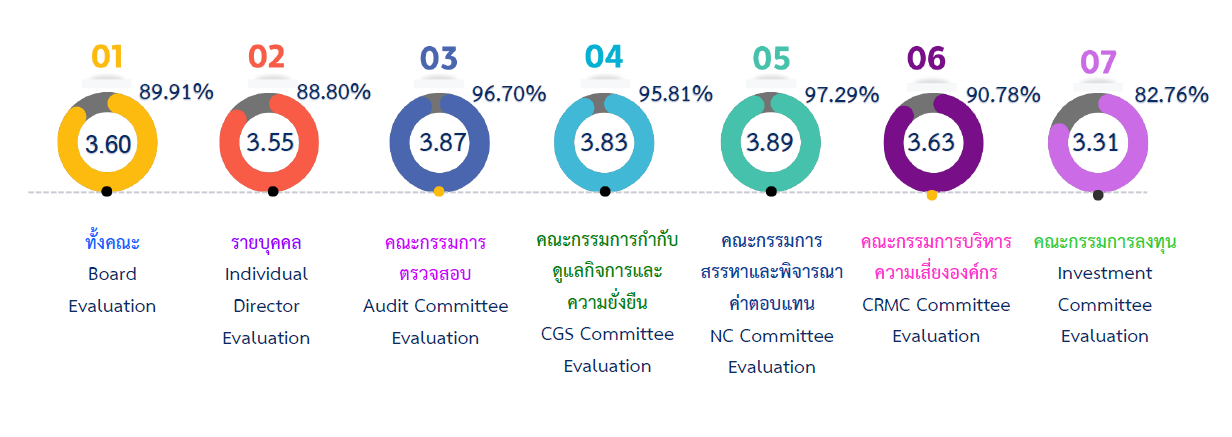
The majority of the Board believes that good or excellent action has been taken in that regard.
Note: Out of a total score of 4, according to the following scoring criteria:
0 = Strongly disagree, or no action taken in that regard
1 = Disagree, or little action taken in that regard
2 = Agree, or moderate action taken in that regard
3 = Somewhat agree, or good action taken in that regard
4 = Strongly agree, or excellent action taken in that regard
Subcommittees
Subcommittees
| Results of the Subcommittee's Duty Performance | Meetings — Introduction |
|---|---|
with Mr. Chokchawal Youngthawornratrakul, Chief Financial Officer Group ( CFO) serves as the Secretary of the Nomination Committee. In 2025, the Nomination Committee held 4 regular meetings and 4 special meetings. The Nomination Committee members attended these meetings to review, approve, and monitor various important operations, as well as report meeting results with comments to the Board of Directors for consideration. The key aspects of its duties are as follows:
The Nomination and Remuneration Committee has fully performed its duties and responsibilities as assigned by the Board of Directors and as stipulated in the Nomination Committee Charter, with prudence, thoroughness, transparency, and independence. It has also provided straightforward opinions for the utmost benefit of DEMCO, shareholders, investors, and all stakeholders, and is committed to performing its duties with equality and fairness according to the principles of good corporate governance, so that DEMCO can develop towards sustainability indefinitely. | The Nomination and Remuneration Committee ("NRC") of Demco Public Company Limited ("Demco") was appointed by a resolution of the Board of Directors to support the operations of the Board of Directors. It possesses powers and responsibilities as stipulated in the NRC Charter, covering the establishment of policies, criteria, and methods for the recruitment of directors and senior executives; the consideration of guidelines, criteria, or methods for determining fair and reasonable compensation and benefits for directors and senior executives; as well as the consideration of criteria or methods for determining compensation for external individuals appointed as company advisors or Board advisors. List of Directors Recruitment and compensation consideration, and meeting attendance between January 1, 2025 - December 31, 2025, as follows: |
with Mr. Natthawat Wansuthan Head of Risk Management Function Serve as secretary to the committee. In 2025, the Enterprise Risk Management Committee held 4 meetings and one joint meeting with the Audit Committee. The Audit Committee will review the risk management system by considering the internal control system that oversees various risks, particularly risks related to financial reporting and compliance with relevant laws, to determine their adequacy and appropriateness. The Enterprise Risk Management Committee, on the other hand, will identify the risk issues faced by Demco Group in order to establish systems for managing those risks. Additionally, information was exchanged and observations were made on issues that each committee member deemed important. The key aspects of the work performed in 2025 can be summarized as follows:
In summary, the Enterprise Risk Management Committee of Demco Group is committed and dedicated to improving and developing the risk management framework and processes, the risk management manual, and other related manuals to be up-to-date and suitable for changing situations. This is to enable Demco Group to effectively and appropriately manage risks, especially Key Risks, Emerging Risks, and Emergency and Crisis Risks, and to control them to an acceptable level. Furthermore, it aims to communicate to stakeholders to inform and ensure their understanding of Demco Group's risk management, thereby building confidence that Demco Group can achieve its set business objectives. | The Enterprise Risk Management Committee has performed its duties as assigned by the Board of Directors in overseeing, supervising, and reporting operational results to the Board of Directors, to ensure that the Demco Group has effective and efficient risk management, and that the Demco Group's operations achieve business objectives, reduce the impact of uncertainties in economic, social, and environmental aspects, as well as build confidence and credibility for shareholders and stakeholders. This also includes ensuring that the Demco Group has a risk management system capable of accommodating risks in all dimensions, based on the principles of good corporate governance in accordance with international risk management frameworks. The Enterprise Risk Management Committee is responsible for defining and reviewing policies and risk management frameworks that align with objectives, key goals, strategies, and acceptable risks. It oversees and supports the implementation of enterprise-wide risk management covering key risks ( Key Risk) and Sustainable Risk, which are risks related to Environmental Risk, Social Risk, and Governance Risk (or ESG Risk), as well as compliance with anti-corruption and anti-bribery measures. This also includes prioritizing risks and defining risk management approaches to reduce the likelihood and impact, as well as setting timelines for actions that can reduce the occurrence and impact of business environment uncertainties arising from changing situations. Furthermore, it provides recommendations for monitoring and evaluating risk management to the management-level Risk Management Committee, and reports risk management results to the Board of Directors, including reporting significant high-risk factors or events, such as Emerging Risk or Emergency and Crisis Risk, that could negatively impact the Demco Group, for the Board of Directors' prompt acknowledgment. Names of the Enterprise Risk Management Committee members from January 1, 2025, to December 31, 2025. |
with Mr. Chokchawal Youngthawornkul, Chief Financial Officer Group ( CFO) serves as the secretary of the Investment Committee. In 2025, the Investment Committee held 4 meetings. The directors attended the meetings and performed their duties according to the Demco Group Investment Committee Charter. The operational results were reported to the Board of Directors, with key summaries as follows:
The Investment Committee is committed to supporting the Board of Directors in screening strategic plans, investment projects, financial management plans, and resource allocation, including monitoring work plans and operational results, to enhance management and competitive capabilities, improve operational efficiency, and sustainably increase the value of Demco Group's business. | The Board of Directors of Demco Public Company Limited (“Demco”) recognizes the benefits and importance of good corporate governance principles (` Good Corporate Governance) as one of its operating principles, which includes focusing on Demco Group maintaining financial credibility by establishing measures to monitor the adequacy of liquidity in business operations, implementing mechanisms to detect signs indicating potential financial problems, and having appropriate and timely action plans to address such issues, aligned with the organization's vision, mission, and goals. In considering Demco Group's investment plans, factors such as business direction, feasibility of investment projects, return on investment, and the adequacy and allocation of the company's funding sources are taken into account, within the framework of investment policy, risk management policy, Demco Group's investment procedures, regulations of the Securities and Exchange Commission, the Stock Exchange of Thailand, and all relevant rules and laws. This is to reasonably assure Demco's stakeholders that Demco Group's operations are directed towards achieving its objectives and goals efficiently, effectively, and sustainably. The Board of Directors has appointed an Investment Committee to support the Board of Directors in scrutinizing investment plans to ensure compliance with the investment policy framework, monitoring plans and investments, as well as managing the financial affairs and liquidity of Demco Group. The Board of Directors has appointed an Investment Committee to support the Board of Directors in scrutinizing investment plans to ensure compliance with the investment policy framework, monitoring plans and investments, as well as managing the financial affairs and liquidity of Demco Group. List of Investment Committee members and their attendance at meetings between January 1, 2025, and December 31, 2025, as follows: |
Ms. Sarinya Chimwai, Manager of the Managing Director's Office, serves as the Sustainability Secretary. In 2025 The Corporate Governance Committee held 5 meetings to consider, screen, and monitor various important operations, as well as regularly report meeting results and opinions to the Board of Directors. The key aspects of its duties are as follows: 1. Good Corporate Governance Aspect In terms of corporate governance, it has supported the operations of the Board of Directors in accordance with the powers and responsibilities stipulated in the Board of Directors' Charter and the Corporate Governance Committee's Charter, in formulating policies and best practices in various areas related to good corporate governance and social responsibility, as well as overseeing operations to comply with relevant rules, regulations, and laws to achieve good governance according to international standards, covering economic, social, and environmental aspects, which will lead to integrated sustainable development. 1.1 Considered guidelines for organizing the 2025 Annual General Meeting of Shareholders in accordance with the situation and proposed them to the Board of Directors for consideration. DEMCO held the shareholder meeting in the form of an electronic meeting ("E-AGM") on April 27, 2025, at the DEMCO office meeting room, in compliance with the Emergency Decree on Electronic Meetings B.E. 2563 (2020) and relevant laws. DEMCO continues to adhere to the principle of granting shareholders rights related to shareholder meetings in accordance with laws and good corporate governance principles, including providing opportunities for shareholders to nominate individuals for election as directors, propose agenda items for the 2025 Annual General Meeting of Shareholders, and submit questions in advance between October 1, 2024, and December 30, 2024. Upon the expiration of the specified period, no shareholders submitted any proposals. Furthermore, in organizing the 2025 Annual General Meeting of Shareholders, DEMCO received a 100% quality assessment score for its Annual General Meeting from the Thai Investors Association. 1.2 Reviewed the ethics and code of conduct for business operations, and updated important policies and practices related to operations, corporate governance, and business conduct to align with the principles of good corporate governance for listed companies in 2017 by the Securities and Exchange Commission ("SEC") and the assessment criteria for the Corporate Governance Report of Thai Listed Companies ("CGR") project in 2024, as well as the Boardroom Guidelines of the Thai Institute of Directors Association ("IOD"). 1.3 Reviewed and revised the charters, and provided suggestions and opinions for improving the charters of various sub-committees to align with the principles of good corporate governance for listed companies in 2017 by the SEC. 1.4 Monitored the results of DEMCO's good corporate governance assessment for 2025 by the Thai Institute of Directors Association ("IOD"). DEMCO received an "Excellent" rating, which is the highest level, for the 10th consecutive year, and provided recommendations for improving operations to appropriately cover all criteria. 1.5 Monitored reports on suggestions and complaints received from DEMCO's stakeholders regarding corporate governance. In the year 2025, no complaints were received. 1.6 Arrange for the performance evaluation of the Board of Directors, including the evaluation of the entire Board, individual directors, and all sub-committees (Board Committee). The evaluation results were reported to the Board of Directors for their acknowledgment and for further development of the efficiency of the Board of Directors and its sub-committees. The evaluation results will also be disclosed in the 56-1 One Report for the year 2025. 2. Anti-Corruption and Bribery Aspect 2.1 Monitor and ensure compliance with the Anti-Corruption and Bribery Policy and the Anti-Corruption and Bribery Handbook. In 2025, no complaints regarding corruption and bribery were found. 2.2 Provide recommendations and monitor the implementation of the CAC project, for which DEMCO has been certified since 2015 and has had its membership renewed for the third consecutive time. 3. Strengthening and Overseeing a Culture of Good Corporate Governance The Board of Directors places importance on organizational culture as it plays a crucial role in shaping the behavior of personnel within the organization and reflects DEMCO's image. Therefore, in 2025, the Corporate Governance Committee monitored the implementation of the manual and best practices for strengthening organizational culture, which were developed in 2022. These include: 1) Manual for Strengthening Organizational Culture, 2) Best Practices for Directors, Executives, and Employees in Strengthening and Maintaining Organizational Culture for Sustainable Business Development, 3) Best Practices for the Sustainable Development Working Group in Strengthening and Maintaining DEMCO's Culture, and 4) Best Practices for Maintaining Board Culture and Board Culture Assessment to ensure continuous and sustainable culture building. 4. Sustainability Aspect In 2025, the Corporate Governance Committee oversaw and monitored the strengthening and implementation of processes to drive the business towards sustainability at the organizational level, ensuring that the implementation of DEMCO Group's business policies and strategies integrates key sustainability frameworks and issues (Materiality) with clear approaches to sustainable development. Personnel at all levels within the organization, from directors, executives, and employees, participate in driving the business forward continuously, so that stakeholders can be confident that DEMCO Group operates its business based on the integration of GRC (Governance, Risk, and Compliance) and maintains its competitiveness, developing its growth potential amidst changing business environments. As a result of this commitment to clear sustainable development, in 2025, DEMCO received the Sustainability Disclosure Award for 2025 from Thaipat Institute (a public benefit organization) for the sixth consecutive year. Furthermore, the Corporate Governance Committee monitored and promoted the implementation of the manuals and guidelines for governing and managing business for sustainability, which were developed in 2022. These include: 1) Guidelines for IT Governance and IT Risk Management Practice, 2) Best Practices for Directors, Executives, and Employees in IT Governance, 3) Best Practices for Emerging Risk Governance, 4) Best Practices for Climate-Related Risk Governance in driving business for sustainability, and 5) Best Practices for the Board of Directors and Management in ESG management and operations, Climate Change, and Climate Governance, to ensure the company's operations align with the changing context. The Corporate Governance Committee has performed its duties in accordance with the Corporate Governance Committee Charter and the responsibilities assigned by the Board of Directors with prudence, thoroughness, transparency, and independence, as well as providing candid opinions for the utmost benefit of DEMCO, shareholders, investors, and all stakeholder groups. It is committed to performing its duties with equality and fairness to all sectors, in accordance with good corporate governance principles, to enable DEMCO to develop towards sustainability. It has emphasized integrating business operations that consider Environment, Social, and Governance (ESG) for good corporate governance, alongside continuous business development for sustainability. | The Corporate Governance and Sustainability Committee ("the CG Committee") of DEMCO Public Company Limited ("DEMCO") was appointed by resolution of the Board of Directors to support the operations of the Board of Directors, in accordance with the scope of duties and responsibilities specified in the CG Committee Charter. This appointment aims to promote and elevate the standards of good corporate governance and sustainable business operations, by considering stakeholders throughout the business value chain, and encouraging DEMCO Group to comprehensively address business risks across environmental, social, and governance dimensions, as well as ensuring the disclosure of corporate governance and sustainable business development information to reflect the true value and worth of DEMCO Group. In 2025, the Corporate Governance Committee reviewed various policies and practices to align with good corporate governance principles and the business operating context, in order to strengthen and oversee the processes for driving business towards organizational sustainability, and to ensure that the implementation of DEMCO Group's business policies and strategies is integrated within the framework and key sustainability issues ( Materiality) and has a clear path towards sustainable development. Personnel at all levels within the organization, from directors and executives to employees, participate in driving the business forward and achieving sustainable growth. This ensures stakeholders that DEMCO Group operates on the foundation of good corporate governance, maintains its competitive capabilities, and develops its growth potential. Even as the business environment changes, DEMCO Group will continue to operate sustainably, consistently considering environmental, social, and governance factors. List of Members Corporate Governance and Sustainability Committee and meeting attendance between January 1, 2025 - December 31, 2025, as follows: |
Meeting Attendance & Remuneration
Meeting Attendance — Sub-section Introduction
The Board of Directors holds Board of Directors' meetings and conducts meetings in accordance with the Company's Articles of Association, Public Law, and the regulations of the Stock Exchange of Thailand at least 6 times per year. Each year, there must be at least 1 Board of Directors' meeting without the attendance of executive directors. Directors are required to attend all Board of Directors' meetings, except in special circumstances. Non-executive directors may also hold meetings among themselves as necessary. Demco has set a schedule for Board meetings in advance throughout the year to enable directors to plan and arrange their time to attend the meetings accordingly. The Board of Directors' meetings have a clear agenda. The Company will send out meeting invitations and meeting materials to directors at least 5 business days in advance of the meeting date to allow directors sufficient time to review the information before attending the meeting. Each meeting lasts approximately 3 hours, except for meetings held for a specific purpose to consider a particular matter, with senior management attending the meeting to clarify details and answer questions from the Board of Directors. The Chairman of the Board provides an opportunity for all directors to express their opinions openly and freely before voting and summarizes the resolutions of the meeting on each agenda item. Directors who have a conflict of interest, whether directly or indirectly, are not entitled to vote and must leave the meeting during the consideration of that agenda item.
Demco prepares minutes of meetings in writing, keeping the originals together with the meeting invitations and meeting materials, and storing copies in electronic format for the convenience of directors and related parties in the audit.
Demco has provided facilities for meetings via video conference or teleconference to enable the directors to attend the Board of Directors' meetings and subcommittee meetings to provide opinions or suggestions that are beneficial to the organization or the Company's operations.
Demco has a policy that the quorum for a meeting of the Board of Directors must consist of not less than two-thirds of the total number of directors to constitute a quorum, and this also applies to the exercise of voting rights on each agenda item. However, if any meeting does not have a quorum of two-thirds, it is at the discretion of the Chairman of the Board to proceed with the meeting using the quorum as stipulated in the Company's Articles of Association (not less than one-half of the total number of directors).
Justification for Directors' Non-Attendance
Notes
The Annual General Meeting of Shareholders for 2025, held on 29 April 2025, resolved to appoint Director No. 10 as a newly appointed director of the Company.
The Board of Directors’ Special Meeting No. 4/2025, held on 30 April 2025, resolved to appoint Director No. 11 to replace a resigning director (replacing Director No. 13).
The Board of Directors’ Special Meeting No. 10/2025, held on 20 October 2025, resolved to appoint Director No. 12 to replace a resigning director (replacing Director No. 15).
Director No. 13 ceased to hold office as a director on 30 April 2025 due to resignation.
Director No. 14 ceased to hold office as a director on 12 February 2025 due to resignation.
Director No. 15 ceased to hold office as a director on 1 October 2025 due to resignation.
Types of Remuneration of the Board of Directors
Criteria for Determining Directors’ Remuneration
The Board of Directors' Meeting has considered and approved the policy and criteria for determining directors' remuneration. The directors' remuneration is structured to be comparable to the levels prevailing in the energy and utilities industries, and appropriate to the experience, duties, scope of roles and responsibilities (Accountability and Responsibility), as well as the expected benefits from each director. Directors who are assigned additional duties and responsibilities, such as being a member of a subcommittee, will receive additional remuneration in the form of meeting allowances. Appropriate benefits are also provided, but must be in line with the growth and strength of the Company's operating results. The Board of Directors will propose the directors' remuneration to the shareholders' meeting for approval.
At the 2025 Annual General Meeting of Shareholders, the meeting resolved to approve the remuneration structure and meeting allowances for the Company’s Board of Directors and Board Committees as follows:
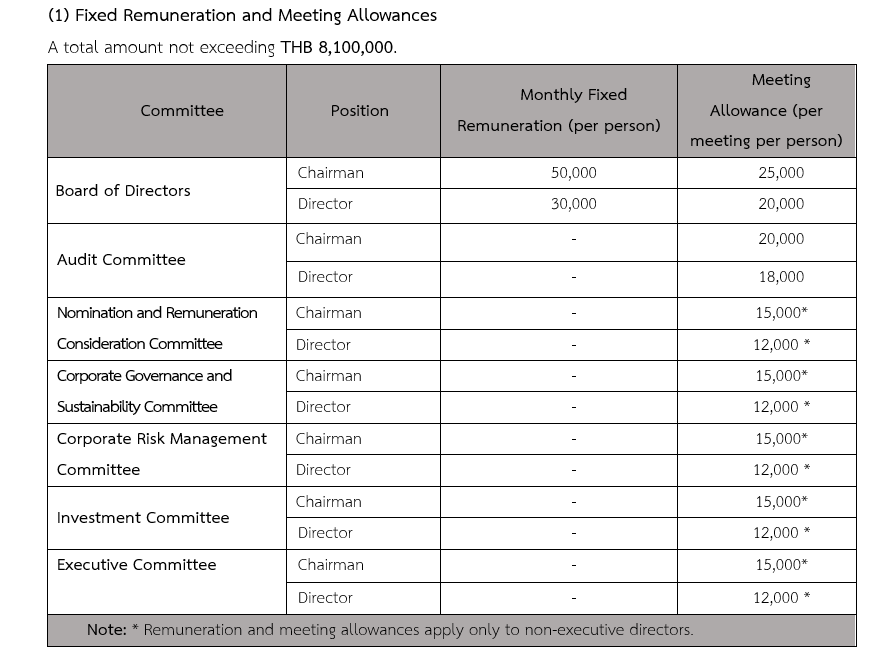
In the event that the Board of Directors appoints additional Board Committees or restructures existing committees, the Board shall ensure that the total remuneration remains within the approved budget of THB 8,100,000, as endorsed by the Annual General Meeting of Shareholders.
Other Remuneration and Benefits Provided Under the Company’s Policies
Annual health check-up and medical expenses of THB 50,000 per person per year
Group life insurance and directors’ liability insurance (D&O Insurance)
Membership fees and expenses related to training programs organized by IOD or other relevant institutions
Directors’ Bonus for the 2025 Performance Year
The annual bonus (directors’ remuneration) for the Company’s directors shall be based on the Company’s performance*. The Board of Directors will conduct both individual and collective self-assessments to evaluate performance each year. The bonus framework is as follows:
Chairman of the Board: Not exceeding THB 500,000 per year
Chairman of Board Committees: Not exceeding THB 400,000 per person per year
Directors: Not exceeding THB 300,000 per person per year
* Company performance refers to an amount not exceeding 1.0% of the total comprehensive income for the year based on the Company-only financial statements.
Bonuses will be considered for payment only when dividends are declared.
The calculation of directors’ bonuses shall be in accordance with the criteria approved by the Board of Directors.
The Company has didclosed its policy and criteria for director's remuneration on tis website. Additional information is available at www.demco.co.th under the section Corporate Governance.
Remuneration of the Board — Introduction
In 2025, the Company paid remuneration to the Board of Directors in the form of salaries and meeting attendance fees as follows:
Remuneration of the Board of Directors
Remuneration or Benefits Payable to the Board
| Metric | Amount (Baht) |
|---|---|
| Remunerations or benefits pending payment to the board of directors over the past year (baht) | 232,000 |
Supervision of Subsidiaries & Associated Companies
Supervision of Subsidiaries — Introduction
The Board of Directors has mechanisms to oversee management and participate in setting important business policies to safeguard the Company's investment. In addition to sending DEMCO executives to be in control of Demco Power Company Limited and Demco Delao Company Limited (Lao PDR), the Board has assigned the Executive Committee to oversee operations. The Board has also established a Subsidiary/Associate Governance Committee Charter to provide a framework for operations. Demco Public Company Limited ("DEMCO"), as the parent company of the DEMCO Group, places importance on managing the companies within the group to operate in a direction that is consistent and aligned with the policies and operations of the Company. This ensures the efficient business operations of the DEMCO Group. The Board of Directors believes that in addition to assigning the Company's Executive Committee to be authorized to propose the appointment of executives with capabilities and expertise in each business area to serve as directors or senior executives representing the Company in subsidiaries or associates as appropriate, to jointly formulate policies and management directions for companies within the DEMCO Group to align with DEMCO's main policies, the Board has also defined the roles and framework for the performance of duties for DEMCO's representative directors. This aims to create a transparent working process, prevent conflicts of interest, and establish procedures for transactions within the group. The defined criteria are consistent with government regulations and relevant laws, serving as a standard for operations, protecting the rights and interests of the Company. The Investment Committee is also tasked with overseeing and ensuring that all subsidiaries or associates operate in accordance with the policies and missions set by the Board of Directors.
The Board of Directors has reviewed and approved the Subsidiary/Associate Governance Policy of Demco Public Company Limited to establish an appropriate "framework, policy, and governance process" for the context of each subsidiary/associate. This aims to maintain a balance between the "degree of control" of the parent company and the "degree of independence" of the subsidiary/associate at a level appropriate to each business and to maximize the benefits of the entire DEMCO Group.
The main objectives of subsidiary/associate governance are as follows:
To establish operational guidelines for subsidiaries/associates that align with the goals and policies of the parent company, for the benefit of the entire DEMCO Group.
To establish a mechanism to control and monitor the operations of subsidiaries/associates to comply with good corporate governance principles and relevant regulations.
To create transparency in the operations of subsidiaries/associates by ensuring that there are no transactions that may result in a conflict of interest or unfairness to stakeholders.
To create channels for effective and timely communication, exchange, and disclosure of information between the parent company and subsidiaries/associates.
To establish a systematic approach (Compliance) to management, internal control, internal audit, and robust and effective risk management.
Focus on the performance and development of the potential (Performance) of subsidiaries/associates based on existing business relationships to create mutual benefits, leading to the sustainability of the entire DEMCO Group.
For more information, please visit the Company's website. www.demco.co.th Under the topic of Corporate Governance
Does the Company Have Subsidiaries or Associated Companies?
Yes
Is There a Mechanism for Overseeing Subsidiaries and Associated Companies?
Yes
Mechanism for Overseeing Management of Subsidiaries
DEMCO will assign its representatives to be directors/executives in each subsidiary/associated company in accordance with the shareholding proportion in each company. This is to supervise and ensure that the subsidiaries/associated companies operate in accordance with the policies, objectives, vision, and strategies of the DEMCO Group, as well as comply with the laws, rules, and regulations of the relevant regulatory authorities. However, the assignment of DEMCO's representatives to be directors/executives in each subsidiary/associated company must be considered and approved by the Nomination and Remuneration Committee and approved by the DEMCO Board of Directors, taking into account the appropriateness of each company.
Directors/executives of subsidiaries/associated companies appointed or nominated by DEMCO are responsible for ensuring that before such subsidiaries/associated companies enter into any significant transactions or conduct any actions that have a material impact on the financial position and operating results of the subsidiaries/associated companies as specified in the Authorization Manual and the Articles of Association of such subsidiaries/associated companies, such matters must be approved by the DEMCO Board of Directors or the DEMCO Shareholders' Meeting (as the case may be) before the subsidiaries/associated companies convene their own board meetings and/or shareholders' meetings to consider and approve such transactions or actions.
The DEMCO Board of Directors will appoint sub-committees, including:
• Corporate Governance and Sustainability Committee to support the DEMCO Board of Directors in overseeing the framework and mechanisms for overseeing the policies and operations of subsidiaries/associated companies.
• The Executive Committee of DEMCO is responsible for overseeing the operations of subsidiaries/associated companies, including filtering or proposing matters that meet the criteria for submission to the DEMCO Board of Directors for approval, related to subsidiaries/associated companies under the DEMCO Group.
To comply with the Corporate Governance Policy and the Policy on Supervision of Subsidiaries/Associated Companies
Oversight Mechanisms
| Mechanism |
|---|
| Sending representatives to act as directors, executives or controlling persons in proportion to shareholdings |
| Defining the scope of powers, duties and responsibilities of directors and executives who represent the company in setting important policies |
| Transactions between the Company and related persons |
| Acquisition or disposal of assets |
| Internal control system of the subsidiary operating the core business is appropriate and sufficient in the subsidiary operating the core business |
Board Duty Performance — Overview
Section Introduction
The success of good corporate governance can be measured by the organization's ability to generate satisfactory growth and returns, as well as its ability to navigate through events that affect business operations smoothly, including helping to create and preserve the value of the organization in the long run. Good corporate governance requires the cooperation of all parties, starting from the Board of Directors, executives, and all employees. Good corporate governance of the Demco Group, therefore, consists of
• Clarity in corporate governance through the establishment of policies, communication, and monitoring of management's performance. There is a development of a corporate governance system, appropriate practices, consistency with the business plan, and compliance with the principles of good corporate governance for listed companies 2017 (CG Code 2017).
• Consulting with management in establishing guidelines for policies, ethics, and code of conduct in conducting business, and monitoring compliance with policies and corporate governance practices that are consistent with both short-term and long-term business strategies.
• Emphasizing and discussing with management to ensure that management understands that effective execution in accordance with good corporate governance principles will lead to improved organizational performance and is not just about creating an organizational culture.
• In the event of incidents that could cause severe damage to the organization or disrupt business operations—such as an earthquake—the Board of Directors and management will safeguard and create organizational value by establishing appropriate and sufficient roles and responsibilities to ensure effective good corporate governance across the entire organization, thereby supporting the long-term sustainability of the Demco Group.
Audit Committee Duty Performance
Audit Committee Duty Performance — Introduction
The Audit Committee of Demco Public Company Limited (“Demco”) consists of 3 qualified independent directors who fully meet the qualifications required by the Securities and Exchange Commission. and Demco's Audit Committee Charter. Two of the audit committee members possess sufficient knowledge, understanding, and experience in financial accounting to review the reliability of financial reports.
In 2025, the Audit Committee independently performed its duties and responsibilities as assigned by the Board of Directors and as stipulated in the Audit Committee Charter, in accordance with the best practices for audit committees as prescribed by the Securities and Exchange Commission (SEC) and the Stock Exchange of Thailand (SET). Including the Best Practice Guidelines for Audit Committees of the Thai Institute of Directors (IOD). It has overseen and supervised Demco's operations to comply with good corporate governance principles, maintain adequate and appropriate risk management and internal control systems, review compliance with relevant laws, rules, regulations, and policies, promote and support adherence to anti-corruption and anti-bribery policies, focus on being a transparent organization, with efficient and effective internal audit systems. As well as ensuring accurate, complete, and timely financial reporting to create sustainable value for Demco and all stakeholders.
Results of the Audit Committee's Duty Performance in the Past Year
During the meetings, the Audit Committee invited management, relevant parties, and auditors to attend various agenda items to discuss important related issues or issues that might affect the operations of the DEMCO Group. This included one meeting with the auditors without the presence of management. The Audit Committee consistently reported the results of its performance to the Board of Directors.
A summary of the key duties performed during 2025 is as follows:
1. Review of Financial Reports
The Audit Committee reviewed the company's financial reports, including both interim financial information and annual financial statements. The company's financial reports were prepared in accordance with generally accepted accounting standards. The review covered material issues, the accuracy and completeness of financial reports and statements, intercompany transactions, significant accounting adjustments affecting financial information and statements, the adequacy and appropriateness of accounting policies, and the scope of the audit. to provide reasonably confident that the financial information and financial statements, including the notes to the financial statements, have been prepared correctly in all material respects, in accordance with legal requirements and financial reporting standards, with sufficient disclosure of important information for the benefit of investors or users of financial reports, and in a timely manner. The Audit Committee approved the financial information and financial statements that had been reviewed and audited by the auditor, which resulted in an unqualified opinion.
Furthermore, the Audit Committee held one meeting with the auditors without management present to discuss the scope of the audit and the independence of the work, access to audit information, material information for preparing financial data and statements, audit limitations, as well as disclosure of information and the presentation of Key Audit Matters (KAM) to be included in the auditor's report. by providing advice and recommendations to make collaboration with management more efficient.
2. Review of Corporate Governance
The Board of Directors promotes sustainable development by ensuring management practices lead to good corporate governance, transparency, reliability, and auditability, which are crucial factors in creating added value for the company and all stakeholders equally. The Audit Committee reviews operations according to established systems to ensure compliance with laws, regulations, requirements of the Securities and Exchange Commission and the Stock Exchange of Thailand, as well as other laws related to DEMCO's business operations. It reviews related party transactions, transactions that may have conflicts of interest, and the disclosure of intercompany transactions in accordance with the policy on related party transactions.
Furthermore, compliance with anti-corruption and bribery measures (“CAC”) was reviewed, and the process for receiving complaints and whistleblowing was promoted and supported. which covers the protection of the rights of complainants and whistleblowers acting in good faith to ensure transparency and fairness. The Audit Committee met with management to discuss the performance under the anti-corruption and bribery policy and reported the results to the Board of Directors. by provided useful recommendations for practices consistent with good corporate governance principles. In 2025, the company had no transactions with conflicts of interest and received no complaints or tips regarding corruption.
3. Review of the Effectiveness of Internal Control Systems and Risk Management
The Audit Committee reviewed the internal control system to align with the good practices of the Securities and Exchange Commission and the Stock Exchange of Thailand, as well as the international internal control framework (The Committee of Sponsoring Organizations of the Treadway Commission: COSO 2013), with the assessment results internal control system that ensures DEMCO's internal controls are adequate, appropriate for business operations, and in accordance with established standards.
The Audit Committee reviewed the efficiency and effectiveness of the risk management process, plans, and guidelines for managing risks that might affect DEMCO's operations under the risk management policy. This included one joint meeting with the Risk Management Committee to integrate collaboration and develop the linkage between internal control, risk management, and internal audit, to be used as a tool for oversight and monitoring. and evaluated DEMCO's operational performance and provided recommendations for further improvement.
4. Oversight of Internal Audit Work
The Audit Committee reviewed and approved the annual internal audit plan and adjustments to the audit plan to link with organizational goals, align with business strategies and changing environments. It reviewed the performance and results of operations according to the defined audit plan, providing recommendations and continuously monitoring corrective actions on significant issues identified in audit reports, to ensure good corporate governance and adequate and appropriate internal controls. Furthermore, it supported the development of personnel in the audit office to possess the knowledge and ability to perform their duties, by The Audit Committee reviewed and approved the annual training plan, as well as emphasized and supported audit staff in developing knowledge and experience to obtain various professional certifications and to possess the knowledge and ability to perform audit work professionally and efficiently. It considered the adequacy of personnel in the audit office, approved the appointment, transfer, and promotion of audit office employees, and evaluated the performance and considered the annual merits of the head of the audit office.
In addition to overseeing the internal audit unit within the company, in 2025, the Audit Committee approved engaged an independent external internal auditor in addition to the work performed by DEMCO's internal audit unit, in order to serves to audit the operations of various units within the company to ensure compliance with established policies and regulations. including auditing information technology systems. to ensure audit operations align with the annual audit plan. It was stipulated that internal audit quality assessments ( Internal Quality Assurance: IQA) annually in accordance with international internal audit standards to continuously develop and enhance the efficiency of internal audit work. The results of such audits and quality assessments are consistently reported directly to the Audit Committee. This operation strengthens and supports internal audit work and consistently reports audit results directly to the Audit Committee.
5. Maintaining the Quality of the Audit Committee
The Audit Committee reviewed its charter at least once a year to ensure its suitability, compliance with the rules, regulations, and criteria of regulatory bodies, and alignment with the duties assigned by the Board of Directors. The Audit Committee reported the results of its performance to the Board of Directors quarterly and provided recommendations for improving governance processes, risk management, internal control, compliance with relevant laws, rules, and regulations, as well as DEMCO's operational processes.
The Audit Committee conducted a performance evaluation of the entire Audit Committee and individual self-assessments in accordance with the evaluation guidelines of the Stock Exchange of Thailand and good practices for audit committees of the Thai Institute of Directors (IOD) to ensure that the Audit Committee's operations are efficient and achieve its assigned missions and plans. The Audit Committee reported the results of the performance evaluation to the Board of Directors and disclosed this evaluation in the annual information statement, Annual Report 2025 (Form 56-1 One Report).
The Audit Committee promoted and supported audit committee members and relevant executives in attending training courses related to audit work and relevant business operations to continuously enhance their potential and operational efficiency. In 2025, audit committee members attended the course ESG in the Boardroom : A Practical Guide for Board and A New Era for Audit Committee : Adapting to Emerging Risks and Evolving Competencies organized by the Thai Institute of Directors (IOD). course Shaping the Future of Accounting Professions, organized by the Federation of Accounting Professions under the Royal Patronage, the Executive Program in Energy Science Class 22 (EEP 22), organized by the Thailand Energy Academy, and the Internal Audit Manager attended the course Head of Internal Audit Unit (Chief Audit Executive Professional Leadership Program), a collaborative project between the Federation of Accounting Professions under the Royal Patronage and the Stock Exchange of Thailand.
6. Consideration of Proposal for Auditor Appointment and Determination of Audit Fees
The Audit Committee considered and resolved to approve Mrs. Natthasarak Sarochonnanjeen, Certified Public Accountant No. 4563, or Ms. Jarunee Nuammae, Certified Public Accountant No. 5596, or Ms. Doranee Somkamnerd, Certified Public Accountant No. 5007, or Mr. Sirames Akarachotikulnan, Certified Public Accountant No. 11821, any one of them from A.M.T. Associate Office, as the auditor for DEMCO for the year 2025, which is the year that Three of the company's operations and proposed to the Board of Directors for submission to the Annual General Meeting of Shareholders 2025 for consideration. The Shareholders' Meeting approved the appointment of the auditor and the audit fee for the year 2025 as proposed.
The Audit Committee performed its duties responsibly as stipulated in its charter approved by the Board of Directors, utilizing its knowledge, abilities, and due diligence, maintaining sufficient independence, and providing constructive opinions and recommendations for the benefit of DEMCO, considering all stakeholder groups. The Audit Committee is of the opinion that DEMCO's management and operations demonstrate continuous development in good corporate governance, possess appropriate and adequate risk management and audit systems, and no significant issues or deficiencies in the internal control system were reported by the auditors and internal auditors. Nevertheless, the company's internal control system still requires continuous improvement to address potential weaknesses, enhance efficiency, and align with the expansion of the group's business. Furthermore, DEMCO's financial information reports are materially accurate, reliable, consistent with financial reporting standards, with sufficient, complete, and timely disclosure, and DEMCO consistently operates in compliance with relevant laws and regulations pertaining to its business.
Executive Committee Duty Performance
Results of the Executive Committee's Duty Performance in the Past Year
Ms. Sarinya Chimwai, Manager of the Office of the Chief Executive Officer and Company Secretary, served as the Secretary to the Executive Committee.
For the fiscal year 2025 There were 13 regular meetings and 6 extraordinary meetings. The Executive Committee has diligently and continuously performed its duties within the scope of authority and responsibilities assigned by the Board of Directors. It has played a crucial role in setting the direction and supporting the operations of the Demco Group to achieve its established goals and policies. The key operational results can be summarized as follows:
-
Formulation of business policies and strategies
The Executive Committee jointly considered and formulated policies, business strategies, operational plans, financial targets, and the annual budget for the Demco Group, taking into account appropriate economic conditions and environmental factors. It also adjusted plans and budgets to align with changing circumstances during the year.
-
Oversight of business operations
Closely monitored, audited, and advised management to ensure that the operations of each business unit adhered to established plans and targets, considering organizational efficiency and effectiveness. Human resource management was conducted, with the Executive Committee considering the organizational structure, personnel management plans, succession planning for executives, performance evaluations, and appropriate compensation guidelines, which were then proposed to the Board of Directors through relevant sub-committees.
-
Consideration of significant investments and transactions
Considered and approved investment projects, joint ventures, and financial transactions in line with the investment policy and budget framework approved by the Board of Directors. The performance of each project was closely monitored, and opinions were submitted to the Board of Directors for significant projects or transactions.
-
Risk management
Supervised risk management operations to align with organizational strategy and promoted a risk management culture at all levels, including reviewing the risk management system at least once a year. Significant risk issues were reported to the Board of Directors.
-
Approval and issuance of important regulations/policies
Considered and approved regulations, policy guidelines, or manuals related to administration to ensure systematic and transparent operations in accordance with good governance principles and auditability.
-
Appointment of advisors and assignment of duties
The Executive Committee considered the appointment of advisors to provide recommendations on important issues within the approved budget, as well as delegating authority to suitable individuals to perform various tasks efficiently. Throughout the year, the Executive Committee performed its duties prudently, transparently, and adhered to good corporate governance principles to support the sustainable growth of the Demco Group.